7 Maine Fall Leaf Peeping Spots Worth the Drive
I drive to Maine every October for one reason, and Maine fall leaf peeping has never once let me down. The state is too big to see in a weekend, so pick a corner, stay put, and let the color come to you. These seven spots are the ones I would hand to a friend, from Acadia National Park on the coast to Baxter State Park in the north woods. If you would rather let someone else drive, start with my New England foliage tours.
Reading the Calendar Before You Pick a Spot

When is peak fall color in Maine? Maine has two peaks, not one. The inland mountains and the north woods turn first, usually from late September into the first days of October, while the coast holds its color into early and mid October. If you want the best places to see Maine foliage in a single week, start inland and end on the coast.
Color moves from high ground to low ground, and a cold snap can pull it forward by a few days while a warm, wet September holds it back. A single windy night can strip a ridge that was perfect the day before, so I never plan around one date on one road. I check the Maine Forest Service foliage report in the week I travel, and I keep two backup stops in mind for every day (Maine Fall Foliage Report).
The calendar also decides the crowd. The first two weekends of October are the busiest in Bar Harbor and on the Park Loop Road, and the Saturdays in between can feel like a slow parade. Midweek is a different state: a Tuesday on the coast gives you the same color with half the cars.
Seven Stops for Maine Fall Leaf Peeping
These are the seven stops I would hand to a friend, in the order I would drive them with four nights and a full tank. Each earns its place for a different reason, and none needs a full day on its own.
Acadia National Park, Where the Color Meets the Sea

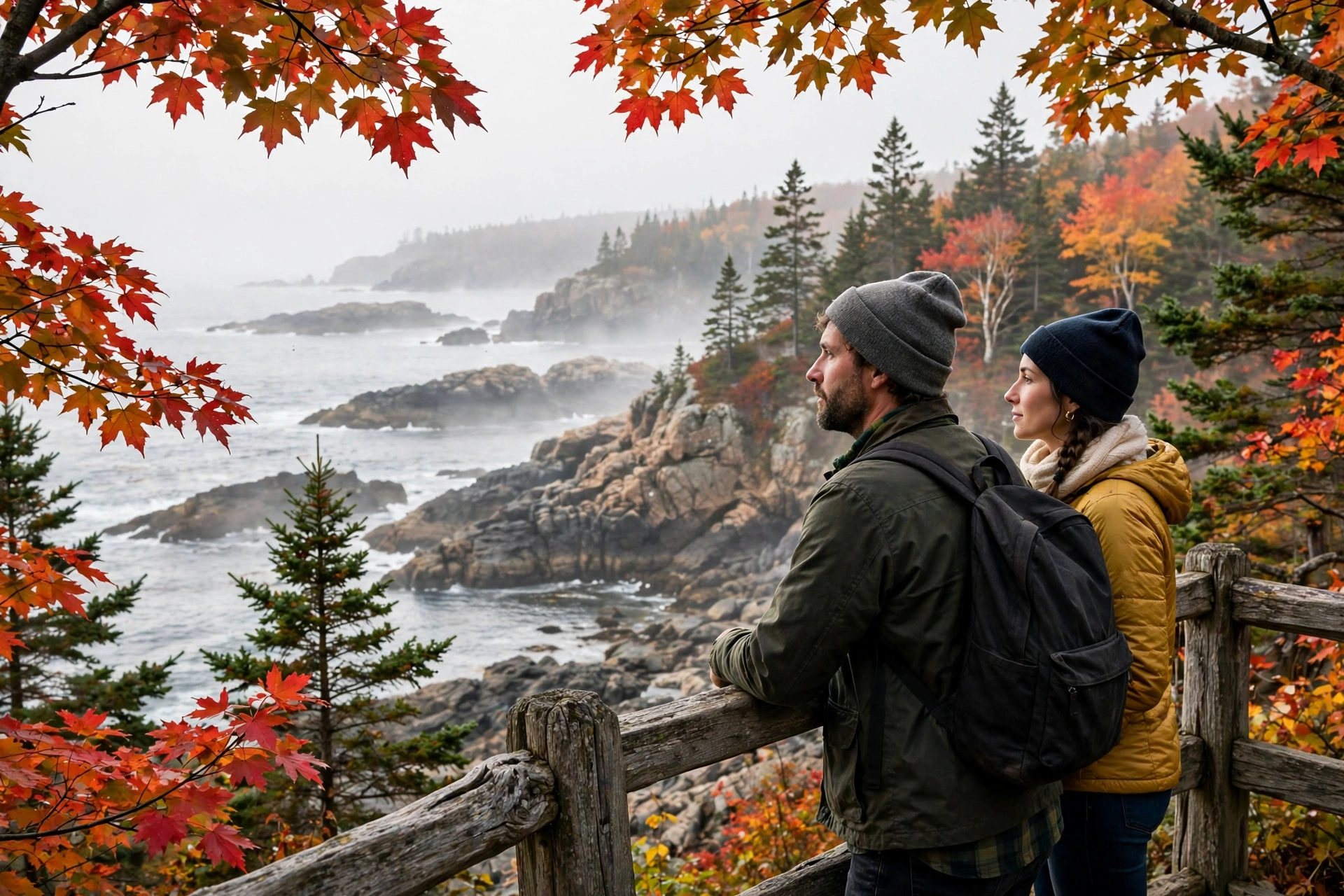
Acadia National Park is the stop I would never cut: nowhere else in New England gives you red maples, granite ledges, and the ocean in the same frame. The Park Loop Road runs 27 miles around the east side of Mount Desert Island, past Jordan Pond and Thunder Hole, and I drive it early, before the tour buses wake up. Treat this as your Acadia National Park in fall guide, short version: drive the loop in the morning, walk one of the 45 miles of carriage roads in the afternoon, and save Cadillac Mountain for sunrise or sunset.
Cadillac Mountain rises 1,530 feet above the water, the highest point on the Atlantic coast of the United States, and the view from the top runs from the Porcupine Islands to the open sea. In season you need a vehicle reservation for the summit road, and sunrise slots go fast, so book online before you leave home. You also need a park pass, so buy it in advance and keep the confirmation on your phone, because signal at the entrance stations is weak (Acadia National Park).
Camden, and the View from Mount Battie
Camden is a working harbor town on Penobscot Bay, and it gives you two kinds of color in one stop: the maples along the harbor and the wide view from above. The short drive up to Mount Battie in Camden Hills State Park ends at a stone tower with a view across the bay, and on a clear morning you can see the whole harbor below you, boats and all. I go up early and walk back down through the woods, because the trail drops through the color instead of past it.
Down in town, the main street is short enough to walk in twenty minutes, so eat breakfast at a counter, buy a sandwich for the car, and leave by nine. Camden works best as a half day between the coast and the lakes, not as a place to spend a whole day.
Rangeley Lakes, and the Height of Land
The Rangeley Lakes are where I go when I want the color without the crowd, and the drive in is half the reason. Route 17 climbs to the Height of Land, a pull off with a view across Mooselookmeguntic Lake, and on a still morning the lake holds the reflection of every red tree on the far shore. The lakes turn early, in the last days of September, so this is the stop I put first on the calendar.
Base yourself in Rangeley and keep the days simple: one lake road in the morning, one short trail in the afternoon, and one dawn start, when the moose come down to the water and the fog sits low over the lake. The town is small, the rooms are few, and the restaurants close early, so book ahead and bring snacks for the car.
Moosehead Lake, the Big Water
Moosehead Lake is the largest lake in Maine, and it feels like it: the water runs for miles, and the color comes down the slopes to the shore in bands of red and gold. I base in Greenville, at the south end of the lake, and drive the east shore road in the morning, when the light is low. Lily Bay State Park, on the east shore, is a quiet place to stop, walk to the water, and eat lunch with no one else around.
One warning: the roads north of Greenville are working logging roads, and the trucks on them do not slow down for leaf peepers. Stay on the paved main roads, pull fully off the road, and never park around a blind curve. The color is not worth a bad meeting with a loaded truck.
Bethel and the Western Mountains
Bethel sits in the western mountains where Route 26 and Route 2 meet, the best base I know for the notch country. Grafton Notch State Park, a short drive north on Route 26, is a narrow pass between steep cliffs, with short walks to waterfalls and pools, and the maples turn a hard red in early October. I drive the notch in the morning, when the sun is low and the cliffs throw long shadows across the road.
Bethel itself is a good overnight town, and from here you can reach the Rangeley Lakes in about an hour or cross into New Hampshire for a day.
Boothbay Harbor and the Midcoast
Boothbay Harbor is a working harbor, not a resort, and I like it better for that. The boats go out in the morning, the gulls work the docks, and the maples turn late, in mid October, after the inland color has faded. Walk the waterfront, take a harbor cruise if the weather holds, and save an hour for the Coastal Maine Botanical Gardens.
The midcoast is also the easiest color in Maine to reach, which is both its strength and its weakness. Route 1 carries everyone south to north, and on a peak Saturday it moves slowly, so I take the back roads through Damariscotta and Wiscasset instead.
Baxter State Park and the Katahdin Road
Baxter State Park is the wildest stop on this list, and the one that asks the most of you. Mount Katahdin rises over the north woods, and the color comes early here, in late September, when the birches turn gold and the maples go red against dark spruce. The park road is dirt and gravel in places, there is no gas and no food inside the park, and day use parking needs a reservation in season, so plan this stop, do not wander into it (Baxter State Park).
I drive in at dawn, when the road is empty and the light is low across the ponds. Katahdin is a serious climb and not a leaf peeping walk, so I leave the summit to the hikers and enjoy the color from the road and the short pond trails instead. If the reservation system sounds like too much, skip Baxter this trip and give the day to Rangeley instead.
Stitching the Stops Into One Drive

Four nights is enough for the whole list if you move once: two nights in the north woods, in Rangeley or Greenville, because the inland color turns first, then two nights on the coast, in Bar Harbor or Camden, and let the later coastal color carry the end of the trip. The best Maine leaf peeping road trip stops share one trait: they sit within two hours of a town with a bed.
The longest single drive on this list is Bar Harbor to Greenville, about three hours, and I would not do it after dark in October. The roads are dark, the moose are out, and the color is invisible until morning anyway.
Coming from the south, the drive up through New Hampshire makes a strong first day, because the Kancamagus Highway in the fall is a slow, beautiful road on its own, and it sets the pace before you cross into Maine.
For the current foliage report and the official list of scenic drives, the Maine Office of Tourism site is the one I check before I leave and each morning (Visit Maine).
Sleeping in Town, Not at the Overlook

The small towns in Maine for foliage trips are the ones where you can sleep, eat, and walk to a view, and Bar Harbor, Camden, Rangeley, Greenville, and Bethel all pass that test. I book two nights in one town and two in another, and I never change towns every night, because packing up each morning eats the best light of the day.
The small towns in New England that work best for leaf peeping are the ones with a main street you can walk and a diner that opens early, and Maine has more of them than any state I drive.
Book peak weekend rooms six to eight weeks ahead, earlier for a specific inn. Midweek rooms are easier, and I have booked good ones two weeks out on a Tuesday. If the room you want is gone, change the town, not the dates, because the color does not care which town you sleep in.
Three Places I Would Not Build a Trip Around
First, the summit road at noon on a peak Saturday. The parking lot fills, the light goes flat, and the view you waited an hour for looks better from the loop road below. Go at sunrise or sunset, or skip the summit for the carriage roads.
Second, Acadia and Baxter in one short weekend. The drive between them is long, both parks deserve a full day, and trying to do both means you see neither properly. Pick one per trip.
Third, Route 1 on a peak Saturday afternoon. The road carries every car going north, the towns slow to a crawl, and a drive that should take an hour takes two. Take the inland roads, drive on a weekday, or save the coast for a Sunday morning, when the road is empty.
The Money Goes to the Room, Not the Road
The scenic drives on this list charge no toll. Acadia needs a park pass, and Baxter needs a day use parking reservation, so check the official pages and buy both before you go. The real money goes to the room and to fuel, because mountain and north woods driving uses more gas than highway driving, and stations are thin past Greenville and Rangeley. I fill the tank every morning and never let it drop below half.
What I Pack for a Maine October
My bag is short, and everything in it earns its place:
- Layers I can add or take off, because a morning overlook is colder than an afternoon town
- A rain shell, because October on the coast can turn wet in an hour
- Downloaded maps and a car charger, because signal fades in the north woods
- Water, snacks, and a small bag for farm stand apples
- Binoculars for the lakes at dawn, and a notebook for towns I want to revisit
Five Things Friends Ask Before Driving to Maine
When is the best week to go?
Drive inland in the last week of September or the first days of October, and save the coast for early to mid October. Weather can shift the color by a week, so check the state foliage report and keep a backup stop in mind.
Do I need a reservation for Cadillac Mountain?
Yes, in season you need a vehicle reservation for the Cadillac Summit Road, and sunrise slots go first, so book online before your trip. You also need an Acadia park pass, so buy that in advance, since cell signal at the park entrances is often too weak to buy one there.
Can I bring kids on a Maine leaf peeping trip?
Yes, and Maine suits kids well if you keep the days short. Drive the Park Loop Road in the morning, stop at Jordan Pond, and spend the afternoon in a harbor town. One short drive, one short walk, and one town stop is the right shape for a day with small kids.
Is Acadia worth it in fall, or is it too crowded?
It is worth it, if you go on its terms. Drive the loop before nine in the morning, walk the carriage roads instead of joining the line at the summit. The color is strongest in the morning light, and the crowds thin fast once you leave the first two overlooks behind.
How many days do I need?
Three or four nights is enough for the seven stops if you move once: two nights inland, then two on the coast. One base town per region means you learn the light and the parking, and stop wasting mornings on packing. A single weekend works for Acadia alone.
Drive North While the Color Holds
Pick one base for the north woods and one for the coast, book the rooms now, and drive north while the color holds. Maine fall leaf peeping is not a race to the reddest tree. It is a slow drive with the windows down, and the best stop is usually the one you did not plan.