Plan San Francisco Hidden Gems Around the Fog, Not the Map
Pick your neighborhood by the weather that day, not by what looks close on a map. That single habit separates a good San Francisco trip from a cold, gray one, because the city runs multiple microclimates at once and the San Francisco hidden gems worth your afternoon are scattered across all of them. The Outer Sunset can sit at 55 degrees under heavy fog while the Mission District is 75 and sunny, four miles apart. Here is how locals actually route a day, plus the stops I steer people away from.

One Forecast, Several Completely Different Days
The city measures seven miles by seven miles and holds wildly different weather across that span.
The mechanism is simple. Cold Pacific water meets warm inland air, fog forms offshore, and it pushes east through gaps in the hills until it runs out of momentum. Neighborhoods west of Twin Peaks get hit first and hardest. Neighborhoods east of the ridge often stay clear all day.
Practical consequences:
- Summer is the foggiest season. July and August are frequently the grayest months, not the sunniest.
- September and October are the warmest. This is genuine local knowledge and the best time to visit.
- Afternoons burn off from east to west. If the west side is socked in at 11 a.m., go east and come back at 4 p.m.
- Dress in layers, always. A 20-degree swing across one day is normal.
Check a neighborhood-level forecast rather than a citywide one. The difference is not marginal.
The Western Edge, Where Almost Nobody Goes
Tourists cluster east. The entire Pacific side stays quiet.
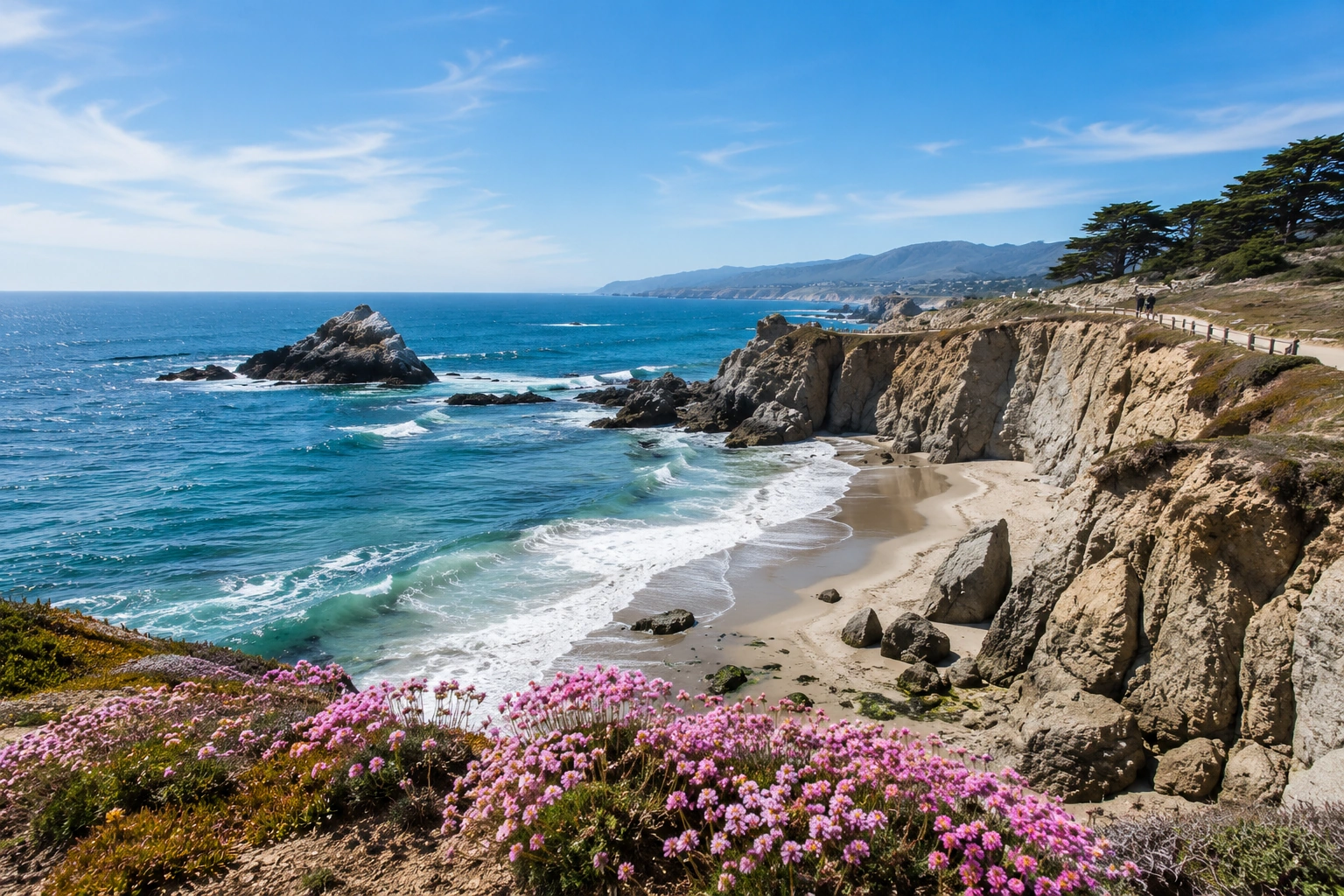
Lands End is the best coastal walking area in the city, run by the National Park Service as part of the Golden Gate National Recreation Area. The main trail follows the cliffs with Golden Gate Bridge views, and at low tide you can see shipwreck remains offshore. Trail details are on the Lands End official page.

At the trail’s western end sit the Sutro Baths ruins, the concrete skeleton of an enormous 1890s swimming complex built by Adolph Sutro. Go at low tide and walk into the ruins themselves rather than viewing from above.
Nearby, the Camera Obscura still operates on the bluff, projecting a live 360-degree image of the coastline onto a dish inside a small building shaped like a camera. It is on the National Register of Historic Places and owned by the Park Service.
Also on this side: Sutro Heights Park for the sunset view over Ocean Beach, and China Beach, a small protected cove that stays warmer and calmer than the open coast.
A warning about Ocean Beach itself. It looks inviting and it is genuinely dangerous. Rip currents and sneaker waves kill people here regularly, and there are no lifeguards along most of it. Walk it, photograph it, do not swim it.
The newest reason to come out here did not exist before 2025. Sunset Dunes is a two-mile oceanfront park running from Lincoln Way to Sloat Boulevard on what used to be the Upper Great Highway. Voters approved the conversion under Proposition K in November 2024, the road closed to cars that March, and the park opened on April 12, 2025.
It holds walking and cycling paths, public art, and a skate area across roughly 77 acres beside Ocean Beach, and it connects to Golden Gate Park at its northern end. Most guides published before 2025 still list this stretch as a road.

The Outer Richmond and Outer Sunset neighborhoods behind these beaches hold the best casual food in the city, particularly along Clement Street and Irving Street. Both stay overlooked because they sit at the far end of every transit line.
The Eastern Neighborhoods That Stay Sunny
When the west is buried, go here.
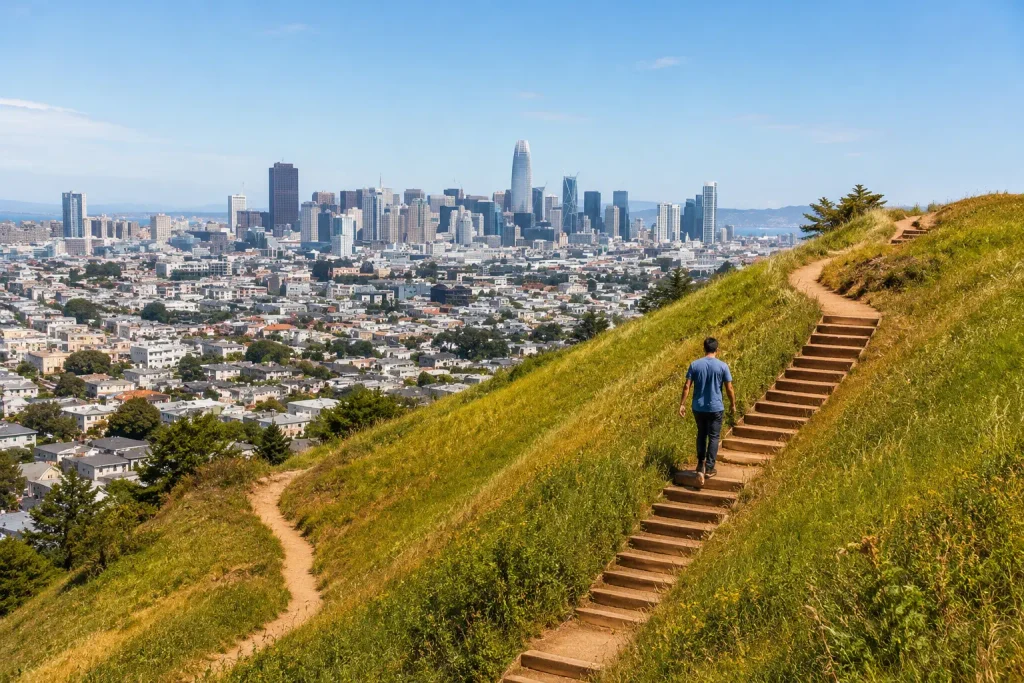
Bernal Heights Park gives you a 360-degree view of the city from a grassy hilltop with almost no tourists, and it clears fog earlier than almost anywhere. Corona Heights Park offers a similar payoff closer to the center.
The Mission District holds the city’s densest concentration of murals. Balmy Alley and Clarion Alley are both single blocks, both free, and both continuously repainted, so what you see changes year to year.
Dolores Park on a clear afternoon is the most reliable people-watching in the city, with a skyline view from the upper terraces.
Two more eastern stops worth the detour. Salesforce Park sits four stories above the ground on the roof of a transit center downtown, runs the full length of a city block, and is free. And the Wave Organ on a Marina District jetty is an acoustic sculpture built from cemetery stone that plays the tide through submerged pipes. Go at high tide or you will hear nothing.

San Francisco Hidden Gems Inside Golden Gate Park
The park runs 1,017 acres, larger than Central Park, and most visitors see one corner of it.
Worth finding:
- The bison paddock. A working herd has lived in the park since the 1890s, near the western end.
- Stow Lake and Strawberry Hill. Climb the island in the middle for a waterfall and a quiet view.
- The Dutch Windmill and Queen Wilhelmina Tulip Garden at the far west corner, which almost nobody walks to.
- The AIDS Memorial Grove, a National Memorial and one of the most peaceful spaces in the city.
- The Shakespeare Garden, a walled pocket planted only with species mentioned in the plays.
The park’s eastern end holds the de Young Museum and the California Academy of Sciences, both worth paying for. The de Young’s observation tower is free to enter even without a museum ticket, which almost nobody realizes.

Park hours, closures, and event schedules come from San Francisco Recreation and Parks.
Stairways That Double as Shortcuts
San Francisco has hundreds of public stairways, and several are attractions in their own right.
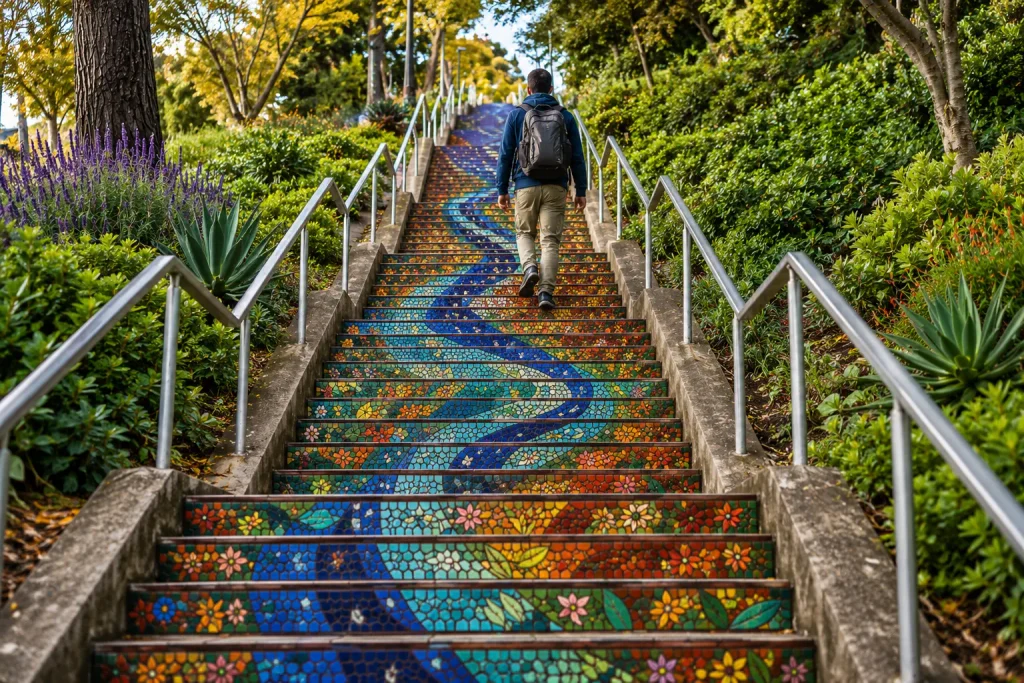
The 16th Avenue Tiled Steps in Golden Gate Heights carry a mosaic running the full 163-step flight. Climb them, then keep going uphill to Grand View Park, locally called Turtle Hill, for one of the best views in the city.
The Filbert Steps on Telegraph Hill climb through private gardens toward Coit Tower, and the neighborhood’s wild parrot flock is often audible before you see it.
The Seward Street Slides in the Castro are two concrete slides built into a hillside. Bring cardboard. Locals do.
One note on the stairways generally: they are steep, and San Francisco hills are steeper than photographs suggest. If anyone in your group has knee or mobility limits, plan the descent rather than the climb, since going down these is harder on joints than going up.
The Warning Most Guides Leave Out
Vehicle break-ins are a genuine and persistent problem in San Francisco, and visitors are the primary target.
Locals call it bipping. Thieves work parking lots at trailheads and viewpoints, break a window in seconds, and take whatever is visible. The Lands End lot, Twin Peaks, and the Palace of Fine Arts are all known targets.
The rules that actually work:
- Leave nothing visible. Not a bag, not a jacket, not a phone cable.
- Do not put items in the trunk at the lot. Watchers see you do it.
- Take luggage into your accommodation immediately rather than sightseeing with it in the car.
- Consider not renting a car at all. Transit and rideshare cover the city well, and parking costs more than most people expect.
Muni routes and fares are on the SFMTA site.
What Closed, What Is Still There, and What Changed
Guides go stale here faster than in most cities, and outdated recommendations waste real time.
The Cliff House restaurant closed permanently in December 2020 after more than 150 years. The Park Service owns the building, and reopening under new operators has been discussed, but do not build a meal plan around it without checking current status. The NPS Cliff House and Sutro Baths page carries official updates.
Louis’ Restaurant, the diner beside it, also closed. The Musée Mécanique collection that once sat at the Cliff House moved to Fisherman’s Wharf back in 2004, where it remains free to enter.

Two road closures also invalidate older directions. The Upper Great Highway is now Sunset Dunes and carries no cars, so any route sending you driving along the ocean between Lincoln Way and Sloat no longer works. JFK Drive through Golden Gate Park has been car-free since 2022, now signed as JFK Promenade. Both remain locally contested, so check current access rather than trusting a cached map.
Overrated Stops I Send People Away From
- Lombard Street. The crooked block is genuinely brief and the surrounding traffic is miserable. Vermont Street in Potrero Hill is crookeder and empty.
- Pier 39. Sea lions are worth two minutes. The retail around them is not.
- The full cable car experience from the Powell Street turnaround. The line runs long. Board at a stop partway up the route instead, or visit the free Cable Car Museum in Nob Hill to see the actual winding machinery.
- Driving across the Golden Gate Bridge as an activity. Walking or biking is the version worth doing. Southbound drivers pay a toll electronically with no booth.
- Fisherman’s Wharf as a dining destination. Go for the Musée Mécanique, eat elsewhere.

Before You Book a San Francisco Trip
When is the best time to visit San Francisco?
September and October. Those are the warmest, clearest months of the year, when the summer fog pattern breaks down. July and August are frequently cold and gray despite being peak tourist season. Spring is variable, and winter brings the year’s rain.
What are the best off the beaten path things to do in San Francisco?
Walk the Lands End coastal trail to the Sutro Baths ruins, climb the 16th Avenue Tiled Steps to Grand View Park, and find the murals in Balmy Alley and Clarion Alley in the Mission District. All three are free, and none draw significant tourist crowds.
Do I need a car in San Francisco?
No, and you are usually better without one. Vehicle break-ins target visitors at trailheads and viewpoints, parking is expensive and scarce, and Muni buses and trains reach nearly everywhere in the city. Rent a car only for day trips outside city limits.
Is the Cliff House open?
The restaurant closed permanently in December 2020. The building is owned by the National Park Service and reopening under new management has been discussed, but confirm current status before planning around it. The adjacent Camera Obscura and the Sutro Baths ruins remain accessible.
What free things are worth doing in San Francisco?
The Cable Car Museum, entry to the Musée Mécanique, all of Golden Gate Park including the bison paddock and AIDS Memorial Grove, the Lands End trail, every public stairway, and the murals in the Mission. A full day of good sightseeing costs nothing but transit fare.
How many days do you need in San Francisco?
Three full days covers the city comfortably without rushing. Four lets you add a day trip to Marin County, Point Reyes, or the East Bay. Two is workable if you pick two neighborhoods and skip trying to cross the city repeatedly.
Check the Fog Map First
Every morning of your trip, look at the neighborhood forecast before you decide where to go. Gray on the west side means head east to Bernal Heights or the Mission. Clear everywhere means go straight to Lands End, because that stretch of coast is the best thing in the city and it is wasted in fog.
Then leave your car parked, or better, do not rent one. That is the whole strategy.
Most lists of San Francisco hidden gems hand you a set of pins with no sequence. The sequence is the part that matters here, because the weather decides it for you every single morning.