
I Read the Royal Caribbean Hidden Camera Lawsuit So You Can Cruise With Your Eyes Open
I have taken a lot of cruises, and I have always treated my cabin as the one place on the ship where I could drop my guard. The Royal Caribbean hidden camera lawsuit changed how I think about that room, and it should change how you think about it too. This is a criminal case that ended in a 30-year federal prison sentence, plus a set of civil cases still moving through a federal court in Florida. I have stuck to what court records, the U.S. Department of Justice, and published reporting have confirmed, and I have marked every allegation as an allegation. Below is the verified timeline, where the lawsuits stand, what Royal Caribbean has and has not said, and the cabin checks I now do.
What the Royal Caribbean hidden camera lawsuit is about
The case centers on Symphony of the Seas, a Royal Caribbean ship, and on a former stateroom attendant named Arvin Joseph Mirasol. The civil side is a proposed class action, Jane Doe v Royal Caribbean Cruises Ltd, filed in the U.S. District Court for the Southern District of Florida. The suit was filed by the Miami firm Lipcon, Margulies and Winkleman, which represents the plaintiffs, and the lead plaintiff is identified only as Jane Doe. The complaint says the proposed class covers passengers who sailed aboard Symphony of the Seas between December 1, 2023 and February 26, 2024 and stayed in cabins serviced by Mirasol. It alleges that as many as 960 passengers may be victims, and it brings claims for invasion of privacy, intentional infliction of emotional distress, and video voyeurism.
Up to 960 is an allegation in the complaint, not a confirmed victim count, and no court has found that figure correct. The class has not been certified, as far as published reporting shows. A filing is a claim by one side, not a finding of liability. The criminal case against Mirasol is over. The civil cases are not, and the company has not admitted wrongdoing.
The complaint also alleges that Royal Caribbean knew or should have known about the risk, pointing to a prior incident in March 2023, when a hidden camera was found in a public bathroom on a pool deck of one of its ships. I have not seen a reliable source name the ship in that earlier incident, so I am not naming one here. Royal Caribbean has not responded to the allegations in the lawsuit, as reported in October 2024.
A cabin discovery in February 2024, and the months before it
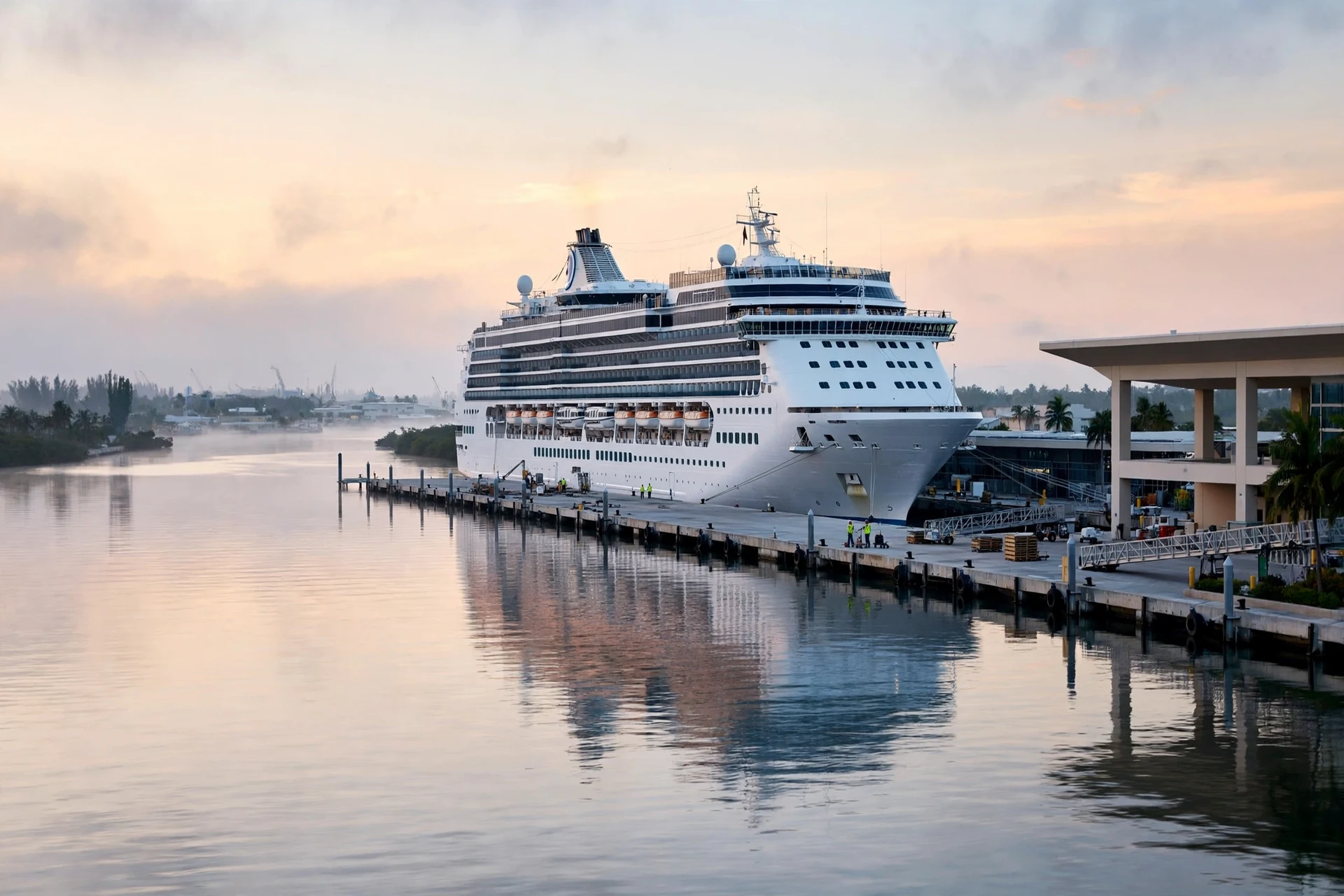
The timeline starts with a guest, not with a lawyer. On February 25, 2024, a guest aboard Symphony of the Seas found a hidden camera under a bathroom sink in a passenger cabin. Ship security detained Mirasol, and the ship returned to Port Everglades in Fort Lauderdale on March 3, 2024, where Homeland Security Investigations and Customs and Border Protection boarded. Those dates come from the Justice Department.
Mirasol was 34 years old, a citizen of the Philippines, and he worked as a stateroom attendant, the crew member who cleans cabins, changes sheets, and restocks towels. That job gave him regular access to guest rooms, including bathrooms, and that access is the heart of the case. According to the Justice Department, Mirasol admitted placing cameras in guest cabin bathrooms since December 2023, around the time he started working on Symphony of the Seas. The cameras were hidden under bathroom sinks. He also admitted hiding under beds to film guests while they showered.
Investigators searched his electronic devices and found numerous videos of passengers, adults and children ages 2 to 17, in various states of undress. The videos were the basis for the federal criminal charge, and they are also the reason the civil cases include claims on behalf of children as well as adults. If you sailed on that ship in that window, the dates matter: December 1, 2023 to February 26, 2024, in a cabin serviced by Mirasol.
The cameras were tucked under a sink, in a spot most of us never look at, which is why the checklist starts there.
The criminal case ended in a 30-year sentence
The criminal case moved fast, by federal court standards. Mirasol pleaded guilty in 2024 to producing child pornography. On August 28, 2024, U.S. District Judge Melissa Damian, sitting in the Southern District of Florida in Fort Lauderdale, sentenced him to 30 years in federal prison, the maximum possible sentence for the charge. The Justice Department announced the sentence the same day, and its statement is the clearest public record of the criminal case.
The Justice Department statement on the sentencing sets out the discovery date, the December 2023 start date Mirasol admitted to, and the search of his devices. It also gives the criminal case number, 24-cr-60046, for anyone who wants to look up the court record. It is a primary source, not a retelling.
That sentence closed the federal criminal case, but a separate state matter followed. In June 2026, Mirasol was booked into the Broward County jail to face nine local counts of digital voyeurism, with a June 15, 2026 change-of-plea hearing listed in Broward County court records. I have not verified the outcome of that hearing, so I am not stating one.
The civil cases, and the fight over arbitration
The civil side started on October 15, 2024, when the class action was filed in federal court in Miami. Since then, at least four civil suits have been filed by South Florida firms on behalf of alleged victims, according to the Miami Herald in October 2025. One of those is a separate suit by Aronfeld Trial Lawyers for 12 children, whose families live in Arkansas, Georgia, Texas, and Missouri.
The biggest legal fight so far has not been about what happened in the cabins. It has been about where the claims get heard. When you buy a cruise ticket, the ticket contract usually includes an arbitration clause, which says disputes go to private arbitration instead of court. Royal Caribbean asked the court to enforce that clause and send the claims to arbitration. The plaintiffs argued that a federal law, the Ending Forced Arbitration of Sexual Assault and Sexual Harassment Act, stops the company from doing that for these claims.
On April 22, 2026, U.S. Magistrate Judge Detra Shaw-Wilder recommended that the motion be denied. On May 26, 2026, U.S. District Judge Darrin P. Gayles adopted her recommendation in full and denied Royal Caribbean’s motion to stay the litigation and compel arbitration. The order cites both the Ending Forced Arbitration of Sexual Assault and Sexual Harassment Act, at 9 U.S.C. sections 401 to 402, and a maritime provision, 46 U.S.C. section 30527. It was reported on May 27, 2026, which is why some reports give that date.
The court order adopting the recommendation and denying arbitration is a two-page document, and it is worth reading if you want the ruling in the court’s own words rather than in a summary. Royal Caribbean had argued that the conduct fell short of sexual contact under the relevant definition, because Mirasol was not alleged to have touched the plaintiffs. The magistrate judge rejected that narrower reading, and the district judge agreed with her.
That ruling was a win for the plaintiffs, but it did not end the case. An appeal to the Eleventh Circuit remains pending, as reported in June 2026, so the underlying claims have not been decided on their merits. A magistrate judge also recommended consolidating 11 individual suits, and Royal Caribbean objected, arguing that a stay in the related class action bars consolidation until the Eleventh Circuit rules.
What Royal Caribbean has said, and what it has not
Here is the short version: the company has not publicly admitted wrongdoing. It reportedly fired Mirasol immediately after the discovery, and it has not responded to the allegations in the lawsuit, as reported in October 2024. When the magistrate judge ruled against its arbitration push in April 2026, the company did not immediately respond to a request for comment, according to the Miami Herald.
Companies in active litigation usually say little, on the advice of their lawyers, and a decision not to comment counts as no admission. It is also no answer. For a passenger deciding whether to book, the silence leaves a gap: no public statement from the company explains what changed in its cabin checks or crew supervision after February 2024, at least none I have verified from a citable source.
The plaintiffs’ firms have described the arbitration ruling as a significant victory, and the lead firm keeps a public page about the case. The plaintiffs’ law firm page on the video voyeurism class action is written by the lawyers bringing the suit, so read it as advocacy, not as a neutral record. It states the plaintiffs’ position in their own words. Treat the Justice Department statement and the court order as the record, and the law firm page as one side’s account of it.
A cabin check you can do on any cruise
This takes about five minutes on embarkation day, before you unpack, and it needs no special equipment. I do it now on every sailing, with my family in the room.
Start at the bathroom. Look under the sink, behind the toilet, and around the shower, with your phone flashlight on. Look for any small object that does not match the fixtures around it, any lens-like glint, or any wire or box tucked where a fixture should be plain. Check the smoke detector, the vents, and any clock or charger that looks out of place. In the main cabin, look under the bed and behind the television and the furniture, and check any object that faces the bed or the bathroom door and has no clear purpose.
Then open the closet, the safe, and the drawers, and note what is already in them. Close the bathroom door and check that it latches. None of these steps proves a room is safe. A careful check lowers the odds of missing something obvious, and it gives you a baseline: if something changes later in the sailing, you will notice it because you looked on day one.
If something looks wrong, do not touch it, do not unplug it, and do not try to take it apart. Photograph it from a few angles, note the time, and call ship security from the cabin phone. Ask for a supervisor by name, write the name down, and keep the room as it is until security arrives. Tell the front desk in person as well, so there is a second record. Keep your own notes, with times and names, in your phone.
For families, add one short conversation before you board. Tell your kids that the bathroom door stays closed when they change, that they should tell you right away if they see a camera or a strange device in the room, and that no crew member needs them to undress or change in front of them.
Before you book your next sailing
I am not telling you to stop cruising. I still cruise. What I am telling you is to book with your eyes open, and to ask a few questions before you pay that you might not have asked two years ago.
Read the ticket contract, or at least the arbitration and dispute sections, before you book. Reading them tells you what forum a dispute would go to, and whether the contract includes an arbitration clause. Save a copy of the contract and your booking confirmation.
Ask the cruise line, in writing, what its cabin inspection and crew access policies are: how often cabins are checked for hidden devices, who does the checking, and what happens when a guest reports a concern. I cannot tell you what any line’s current policy is, because I have not verified a citable source of it.
Questions I keep hearing about this case
How many people were affected?
That is not a settled number. The complaint alleges that up to 960 passengers may be victims, based on the cabins Mirasol serviced between December 1, 2023 and February 26, 2024. Investigators found numerous videos, including videos of adults and children ages 2 to 17. No court has confirmed a total victim count.
Can the passengers sue in court, or do they have to go to arbitration?
For now, they can proceed in court. A federal judge denied Royal Caribbean’s motion to compel arbitration in May 2026, ruling that the federal arbitration law for sexual assault and sexual harassment disputes blocks the ticket contract’s arbitration clause for these claims. The company has appealed to the Eleventh Circuit, and that appeal is still pending, so the answer could change.
Has the class been certified?
Not as far as published reporting shows. The suit was filed as a proposed class action, which means the court still has to decide whether the case can proceed as a class. A filing does not equal a certified class.
What if I sailed on Symphony of the Seas in that window?
If you were aboard between December 1, 2023 and February 26, 2024 and stayed in a cabin serviced by Mirasol, the class definition in the complaint may cover you. That is a legal question, and this article is not legal advice. If you think you may be affected, consider speaking with a lawyer who handles cruise passenger claims, and keep your booking records and sailing dates.
What I would do with this information
I would keep cruising, and I would stop treating my cabin as a private space that no one else can enter. I check the bathroom first, I look under the bed, I note what is in the room before I unpack, and I talk to my family about it in plain language. Five minutes, once, on day one, and then I relax and enjoy the sailing.
The Eleventh Circuit appeal is pending, the consolidation question is tied to it, and the underlying claims have not been tried. Either way, the criminal sentence stands, and the facts the Justice Department published stand with it. Book the sailing you want, do the cabin check, read the contract, and keep your records.